
The lens, formed where the stakes are highest.
The most important forces at work in an organization are usually the ones no one is looking at. Not because people aren’t paying attention — because attention narrows over time. The relational architecture beneath the org chart. The culture running under the stated mission. The pattern quietly organizing everything. I see that layer first. The practice is what happens next.
Where the lens comes from
The work began in the most consequential human systems there are: early childhood, special education, infant mental health, and the families and communities around them. These are the places where the patterns that shape a life are either formed or fractured: where attachment is built or disrupted, where trust is found or never quite established, where the conditions for growth are present or absent. When the stakes are that high, you learn to see in a particular way: to find the latent structure, to notice what’s present but unnamed, to recognize the organizing logic beneath what a system shows on its surface.
That way of seeing does not stay inside a field. It follows you into every room you enter.
When I began working with organizational leaders, across sectors and across levels, I brought the same lens. Not what is stated, but what is operating. Not the strategy on the whiteboard, but the dynamics beneath the table. Never the résumé alone — always what it took to earn it. The scale changes; the pattern does not.
And the field itself has stayed. Infant and early childhood mental health — early relational health, as the field increasingly names it — early intervention, and the early childhood workforce are where the lens was made. It points wider now: the workforce in front of families with children, and the funders, public agencies, and intermediaries responsible for it.
Relational health is not a stage anyone ages out of. It describes how development works — in a two-year-old, in the home visitor at the kitchen table, in the pediatrician between one appointment and the next, in the director carrying a system. That is what makes it a method for a whole workforce rather than a specialty inside one.
A practitioner learns relational health as knowledge about the families in front of them. Somewhere in the learning it turns around: they understand their own supervision differently, their own team, their own history in the work. The field has a name for that mirroring — parallel process — and it is the mechanism, not a side effect. The lens does not shift because someone was told to shift it. It shifts because they recognized themselves inside what they were learning.
That lens stands behind the coaching and the advisory work. At full depth, it is the expertise itself: what a courtroom asks for, what a policy question turns on, what a conference invites to the stage. Same root. Different depth.
The settings change; the work does not. Public agencies and foundations, nonprofits and leadership teams, boards, companies, and the people who run them. Systems, leaders, teams, and organizations that grew — and held. In every one, the offer at its core is the same: the layer you cannot see from inside, made visible — and made useful.
A matter of public record
From May 2023 to May 2025 I ran a $1 million state grant building the workforce development system for infant and early childhood mental health practitioners — under contract to MSPCC, a division of Eliot Community Human Services, which held the award from the Executive Office of Health and Human Services. I supported the planning and coordination that brought every course live, wrote the marketing materials that recruited participants, and stayed with both trainers and participants from the first communication to the last session. Every seat in every training had to be applied for. I read every application, made the acceptance decisions, and composed the cohorts. Those applications are where the data system began — they were its first records, and both the tracking systems and the architecture I authored for the statewide platform were built on what they held. It is still in use today. The competency structure is the Alliance for the Advancement of Infant Mental Health’s. Every training counted toward endorsement, and the grant separately funded endorsement for 80 practitioners.
Boston University now leads the independent impact evaluation. It recruits from a branch of that system built for the study — a recruitment database carrying demographics, education level, and years of experience in the field and in infant and early childhood mental health. Every application asked, up front, whether the applicant wanted to take part. I hold a Co-Investigator appointment on the study team.
The pattern is older than one contract. Nine years of it ran through the two children’s hospitals ranked first and second in the country. At Children’s Hospital of Philadelphia I directed all clinical and administrative operations of a two-county early intervention program — a $2.1 million budget, 20 interdisciplinary professionals — along with the program systems that recovered $700,000 in unrealized revenue and kept its doors open. Boston Children’s was the teaching side. I built and led the training and education function of its early intervention program: the university partnerships, the practicum curricula, and the supervision of graduate clinicians and pediatric residents from both Boston Children’s and Boston Medical Center. I held state Early Intervention Specialist certification as a supervisor of record, moved staff toward the same certification, and led a lean-principles redesign of clinical workflow.
Three of us rewrote Northeastern University’s early intervention program to the state’s revised competency framework and took it through Department of Public Health approval — competency architecture for a regulated profession. I supervised year-long practica and coordinated field education across early intervention programs statewide, and sat as Higher Education Representative on the state’s Early Childhood Outcomes Stakeholder Group, on evidence-based practice under federal regulation.
Two cohorts of staff at Horizons for Homeless Children earned Lesley University’s Certificate in Childhood Homelessness Studies at no cost to themselves — roughly $500,000 in tuition, unlocked by a $17,000 board donation that covered half the lecturer salaries. I brought the certificate in; the first cohort started September 2018. I then secured $75,000 for Brazelton Touchpoints training across the whole organization, including the cost of becoming a Touchpoints site and putting three staff through train-the-trainer. Horizons is still a Touchpoints site. A team of us brought in RISE, Tufts University’s two-year research program in science, technology and engineering for young children, and I was responsible for it while it ran on site.
Elsewhere: a research and evaluation department built and directed inside a Head Start organization, and a faculty lectureship at four universities.
None of it was won on vision statements. It was procured, scoped, delivered, and audited.
Rigorous and relational
Working with me is not a linear process. Every engagement starts from what is already present — the specific system, the specific people, the specific moment — read closely before anything is prescribed. Where the next level asks for more than the system can currently supply, that is what I carry in. And I carry it in to strengthen what is yours, never to substitute for it.
What clients notice first is precision — the pattern surfacing before the presenting question has been fully described. I process structure before content, across domains, without needing to be told where to look. Alongside it runs attunement: reading a leader, a team, or a room with the same accuracy I bring to the system itself. What is said, and what is not. What a person is managing, beneath what they present.
What clients notice next is that the work feels like theirs. Not handed to them — emerged from them. The shift feels self-generated because it is. And what arrives from outside becomes theirs too: held, not borrowed.
What they don’t always expect is the honesty. The work holds space and holds people accountable — and when the comfortable path stops supporting the growth, I say so. That moment is proof the foundation can bear weight.
And what remains at the end is independence — not a dependency on me, a capacity in you.
The IMH-E® and RS/C® are advanced endorsements in early relational health, human development, and reflective practice inside complex systems. Both are conferred through the Massachusetts Association for Infant Mental Health and held to the international standards of the Alliance for the Advancement of Infant Mental Health, whose endorsement system spans thirty-six states and reaches internationally. Few consultants working in leadership, organizational culture, or workforce design carry them. They are the credentialed form of the lens itself.
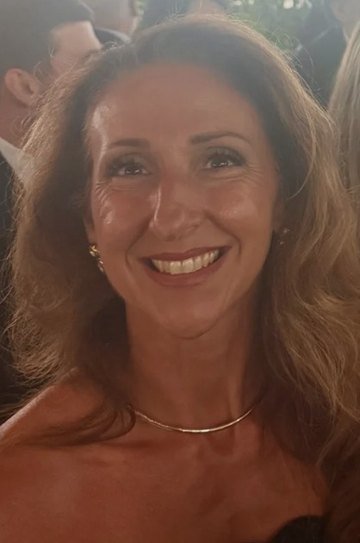
A real photograph — a family wedding, this past summer. Nothing staged, nothing retouched.
I’m real. The work is real.